|
Confederate States of America
(1860-1865)
U.S. Possessions
- Canal Zone (1904-1938) (complete)
- Cuba (1899-1900)
- Guam (1898) including Guam Guard Mail (complete)
- Philippines (1899-1907) (complete)
- Puerto Rico (1899-1900) (complete)
- Virgin Islands (purchased 1917)
The Guam listings include plate number examples of special printings for the 1900 Paris Exposition and Guam Guard Mail.
The Phillippines listings include plate number examples of special printings for the 1900 Paris Exposition, 1904 St. Louis World's Fair, and Bureau of Insular Affairs archives (1907).
Specially overprinted stamps were not issued for other U.S.
possessions.
Hawaii was annexed in 1898, about the same time that specially overprinted stamps
were being issued for the former Spanish colonies of Guam, Puerto Rico,
Philippines and Cuba, yet the transition in Hawaii moved directly from
stamps of Hawaii to regular issues of the U.S.
Stamps of Hawaii as a kingdom or independent republic did not feature plate numbers.
The U.S. Virgin Islands were purchased from Denmark in 1917.
Regular U.S. issues immediately superseded stamps of the Danish West
Indies. No overprints were produced.
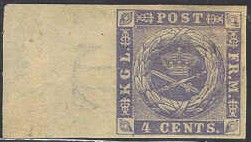 Danish West Indies Scott 4a, "T" in
selvage Danish West Indies Scott 4a, "T" in
selvage
Several series of revenue stamps have been issued for U.S. Virgin
Islands. They are not overprints of U.S. regular issues or revenues,
but were specially printed by BEP for use in the U.S. Virgin Islands.
Examples of plate number singles of the 1935 series and 1965 series are unusual but they do exist. Plate number items of earlier series have not been reported.
Virgin Islands revenues
- U.S. Postal Agency in China / Offices in China / Shanghai overprints
The U.S. operated a postal service in Shanghai, China from July 1919 to December 1922. Stamps of the 1917 unwatermarked Washington-Franklin series were overprinted with amounts double the stamps' original face value.
Offices in China
The U.S. acquired a number of Pacific island territories, but no
special overprinting was done for the Marshall Islands, American Samoa,
Midway, Wake, Howland, Jarvis, Johnston Atoll, Baker Island, Kingman Reef, Palmyra Atoll, the Line Islands, Micronesia, the Ryukyus, or other Pacific
territories. Clipperton Island is also claimed by Mexico and France. Some are now independent (Marshall Islands, Federated
States of Micronesia), others have been returned or reunited with their
home country (Ryukyus, Phoenix Islands, Enderbury Island), while still others remain part of the U.S. The U.S. claim to Ducie Island is dormant and the island is now administered by Pitcairn. It is possible to find covers bearing plate number
singles of regular U.S. issues that have been canceled in those places.
The U.S. acquired or claims several unpopulated islands in the Caribbean area. No
special overprinting was done for Corn Island, Swan Islands, or for Navassa Island, which is also claimed by Haïti. Baja Nuevo Bank is also claimed by Jamaica, and is administered by Colombia after it took over Nicaragua's former claim in 2012. Roncador Cay and Serrana Bank were ceded to Colombia in 1981. Serranilla Bank is also claimed by Honduras and Jamaica, and has been administered by Colombia since it took over Nicaragua's former claim in 2012. Serranilla Bank is the only island supporting a population, a Colombian garrison. It is possible to find covers bearing plate number
singles of regular U.S. issues that have been canceled on naval vessels visiting those places.
According to the Antarctic treaty, no country is allowed to formally
claim any part of Antarctica, but all nations are welcome to establish
scientific and exploratory bases. Some countries have issued special
stamps for use by their scientific and support teams. For example,
Australia issues separate stamps for the Australian Antarctic Territory,
whereas France includes its Antarctic bases in stamps issued for FSAT, the
French Southern and Antarctic Territories. However, the U.S. has not
issued separate stamps.
Standard military mail sent within the regular mailstream requires
standard U.S. postage. Some military departments used Official
stamps for some mailing purposes, when those were current. Military mail sent from regular
bases in non-combat zones uses standard U.S. postage. Military mail
sent from active soldiers in combat zones is sent free and thus would not
have plate number singles.
The U.S. Army has operated field or base post offices, and the U.S. Navy has operated fleet post offices, for troops
stationed in various foreign countries as part of peace-keeping efforts,
police actions, or outright war. No specially overprinted stamps
have been issued for this purpose.
Local military officials overprinted Mexican stamps for use during the seven month occupation of Veracruz in 1914. No plate number examples are known. It has not been established whether this is because the original Mexican stamps did not have plate numbers, or the selvage was removed during the overprinting process, or examples are possible but have not surfaced in auctions or the philatelic press. This is an area for further study.
No stamps were issued or overprinted for use during U.S. occupations of Panama before its secession and independence (1846, 1856, 1885, 1889); of Cuba (1906-09, 1912, 1917-22), other than the original series of overprints linked above; of the Dominican Republic (1903, 1904, 1914, and the 1916-24 occupation); of Honduras (1903, 1907, 1911, 1912, 1919, 1924 and 1925); of Nicaragua (1912-33); or of Haïti (1915-34). Ship covers are known from various naval vessels supporting those actions. Plate number singles are possible on such covers, although no examples have been reported. No plate number singles have been reported on covers from U.S. military actions in Mexico in 1916-17.
In 1944 and 1945, the U.S. Fleet Post Office overprinted the 6¢ Transport Airmail with various types of "R.F." overprints for use by French naval personnel on airmail from French naval vessels to the U.S. and Canada. Authentic uses must be on cover, and no plate number examples are known. A fake example is illustrated on the AMG-France page.
No stamps were issued or overprinted for use during the U.S. occupation of Japan following World War II. The Ryukyu Islands issued their own stamps until they were formally reincorporated into Japan in 1972.
See links below related to stamps of the Allied Military Government for use in France, Italy, Germany and Austria.
Official diplomatic mail sent by diplomatic courier does not require
postage.
Official mail sent within the country represented uses the stamps of
that country.
Personal mail sent to U.S. addresses by employees in overseas
embassies, consulates and other offices can be included in the regular
diplomatic pouches. Standard domestic postal rates apply. Stamps must be affixed, and such mailings are canceled in Washington,
D.C., where they enter the mailstream. Plate number singles may
exist on modern diplomatic mail, but would have to be collected on cover.
Celestia or the Nation of Celestial Space was declared as the owner of all outer space by an Illinois resident in 1948. The micronation issued both stamps and gold and silver coins, including at least one stamp issue with plate numbers that is illustrated here.
Allied Military Government (AMG)
Special stamps were produced for use by citizens of France, Germany,
Austria and Italy (Sicily), using the military postal service run by the Allied
Military Government immediately after World War II. These services
were superseded when infrastructure, personnel and procedures were
established and local postal service could resume.
- France
(1944-1945) (complete)
-
Germany (1945-1948) (complete)
-
Austria including postage due issues (1945-1948) (complete)
- Italy
(1943-1946) (complete)
The 8 pfennig and 12pf values of the Washington printings of the AMG-Germany issues were overprinted for use as travel permits to or within occupied Germany. Plate number items may exist, but have not been reported.
The Soviet government also issued military stamps for the Soviet Zone, later to become East Germany or the German Democratic Republic. The stamps were printed with counting numbers, rather than plate numbers.
AMG stamps for Trieste are considered issues of post-war Italy.
Overprinted stamps issued for use in Saarland under the League of Nations (1920-35) or France (1946-57) are considered issues of Germany. It is not clear if there was an overlap between the use of AMG-Germany stamps and stamps under the French occupation, or if any plate number examples might exist. This is an area for further study.
We are deeply indebted to APNSS member, the late Wallace Cleland, for generously
sharing examples of these AMG issues. Many of the plate number singles
shown here are
photographically cropped from images Wallace used to illustrate his series
of articles on AMG
plate blocks. For more information, see the April 2006 through October 2006 issues of
The United States Specialist, published by the
United States Stamp Society.
Technically, the U.S. considers incorporated territories an integral part of the U.S., rather than possessions. However, collectors generally refer to stamps issued for use in these U.S.-related incorporated or unincorporated territories as "possessions."
Comments? Suggestions? Email the
Webmaster: 
This page last updated May 2, 2021.

|