The American Plate Number Single Society
HOME

ABOUT APNSS

NEWS

MEMBERSHIP
Becoming a member
Officers and Directors

NEW PLATE NUMBERS

PUBLICATIONS
Plate Numbers
Articles
Hebert's Catalog
Classified ads

VIEW EXAMPLES

LINKS
American Philatelic Society
United States Stamp Society
Linn's Stamp News
Scott Publishing

...More


State Hunting Permit stamps

Individual states and Indian reservations can require waterfowl hunting permit stamps, in addition to the federal stamp.

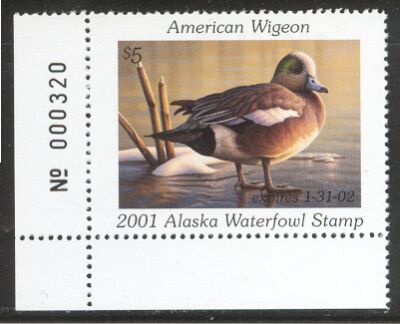
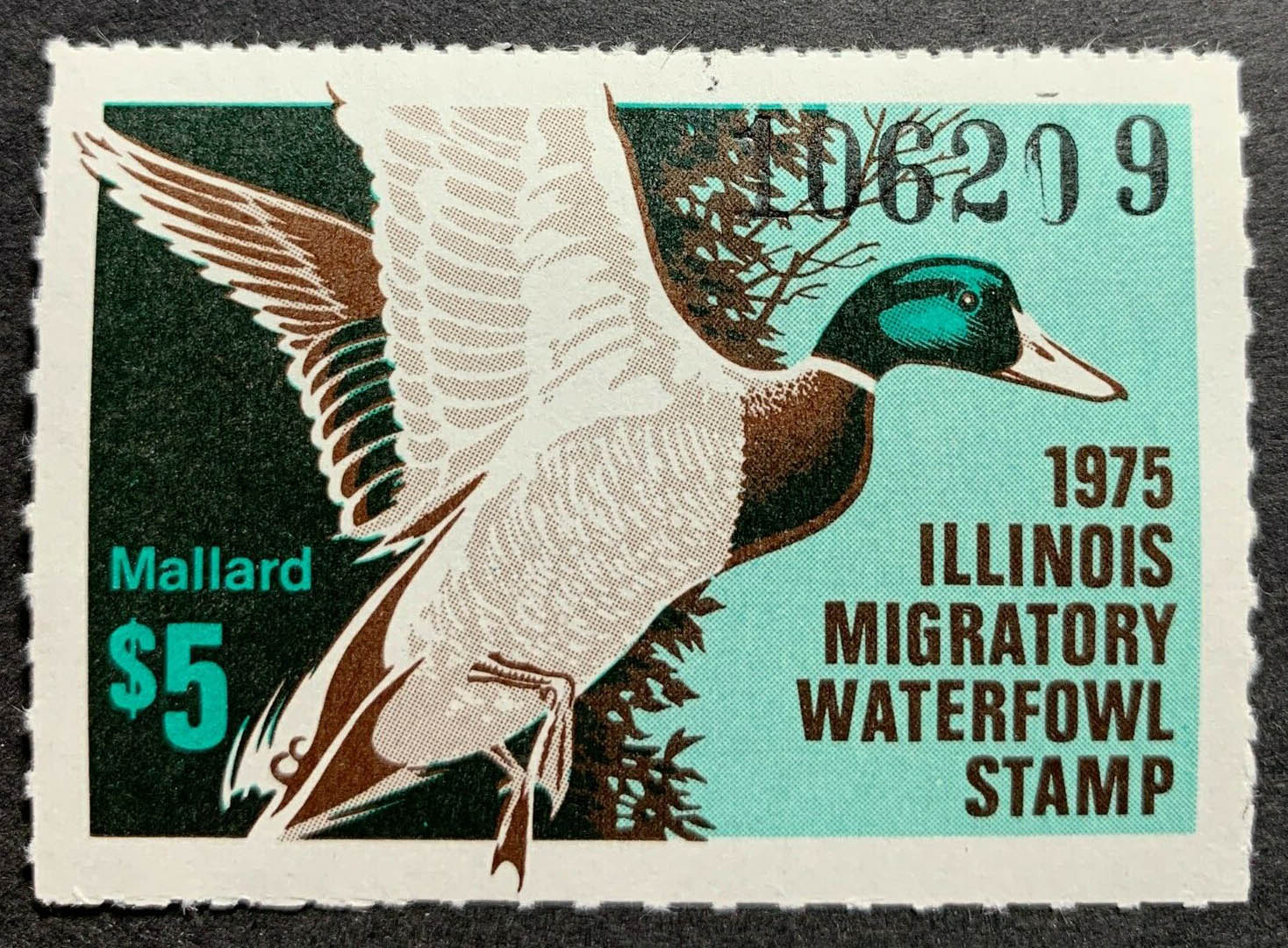
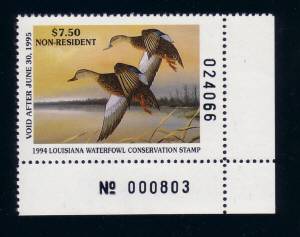
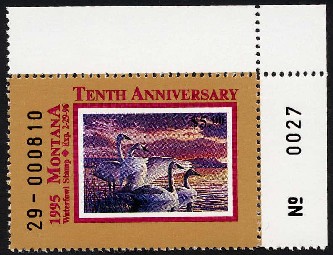
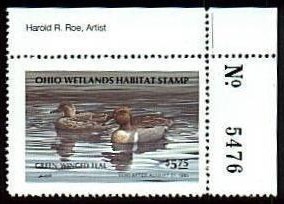
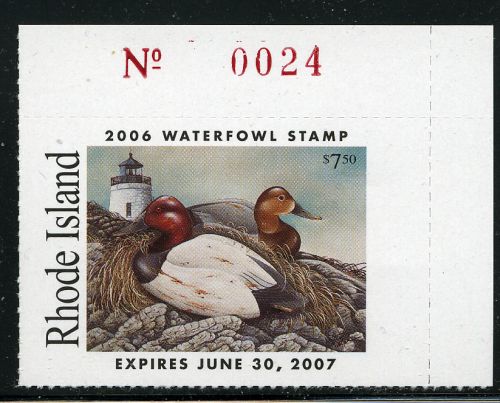
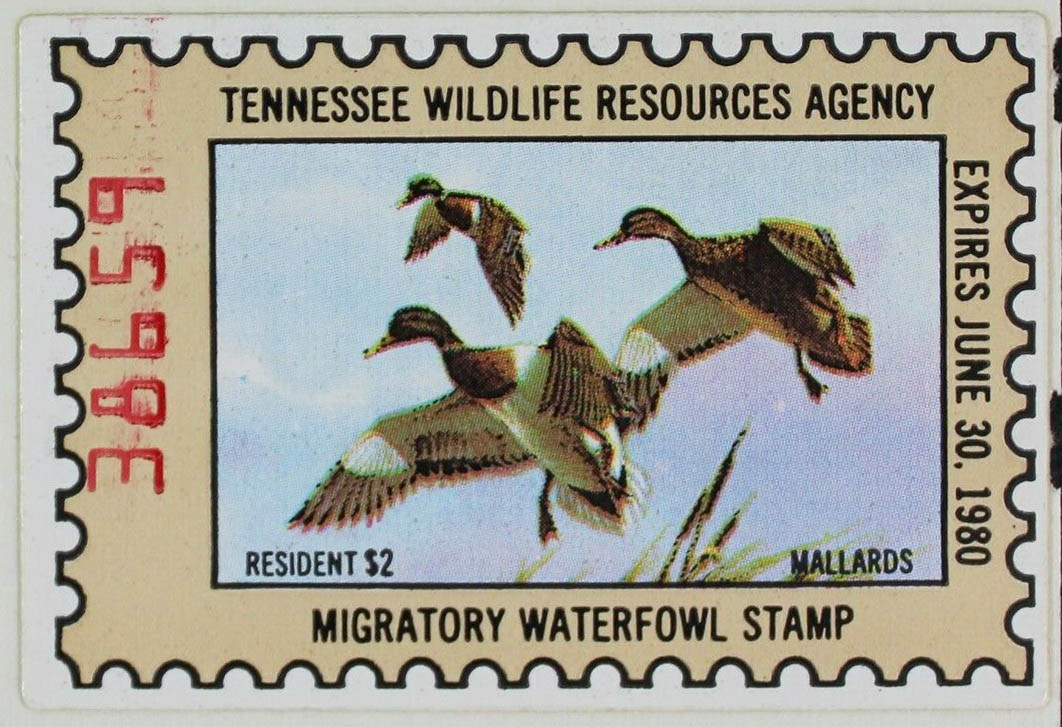
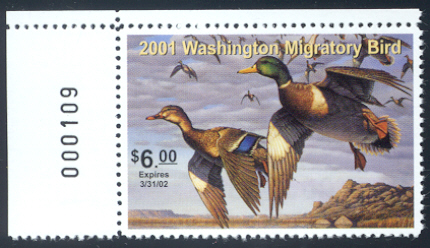
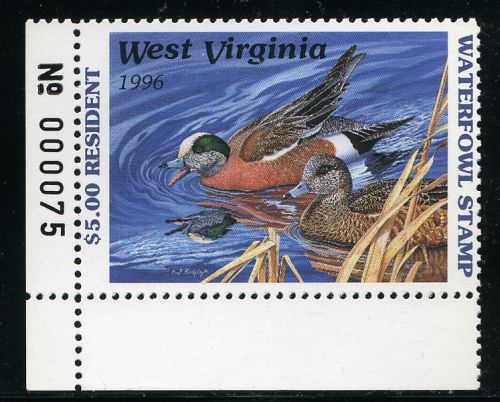
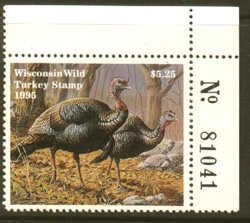
Although they are frequently offered as "plate numbers," the numbers printed on the vast majority of state duck stamps are actually serial numbers. Some serial numbers appear in the selvedge, much like a plate number, while other serial numbers are printed on the face of the stamp itself. Again, these serial numbers are not true plate numbers. These serial numbers are typically printed in black in a separate process from printing the stamps themselves, which may not even include black in their design, or in red if the stamp itself is printed in black.

On some Michigan issues, the highest serial number appearing on the pane is reprinted in the selvage, essentially functioning as a counting number. These are not true plate numbers.

Some states also require permit stamps for hunting of other birds and animals, such as fish, turkeys, pheasant, woodcock, deer, elk, moose and even bears, as well as for different hunting methods such as black powder or bow and arrow.

Some states issue separate stamps with different fees for residents vs. non-residents, or for a reduced rate for teenagers, seniors, or for residents of a bordering state that shares a river or a dammed lake. A few states have recognized the potential revenue in the collector market by issuing "governor's editions" and other stamps with large surcharges. Very, very few are known with true plate numbers.

Trial color large die proofs of the 1955 Michigan Trout stamps exist in green and violet with a 5-digit die or reference number, but these are not plate numbers. Plate numbers do not appear on printed proof sheets or the issued stamps.

Maryland also issued crabbing permit stamps in booklets of 10. The individual stamps have six-digit serial numbers. The lower and upper serial numbers are printed on the booklet tab. They might look a lot like plate numbers, but they are not.

Here are some examples of exceptions featuring true plate numbers.


New Jersey

unlisted, $2 NJ Division of Fish, Game and Wildlife $2 Woodcock stamp (1983), possible plate number 5041 in the same light green ink as the stamp. Note: the 1982 NJ Woodcock stamp features a serial number, not a plate number; older issues as well as NJ resident and non-resident trout fishing stamps as far back as 1953 have neither plate numbers nor serial numbers. (Image courtesy of eBay / ckstamps)

unlisted, $2 NJ Division of Fish, Game and Wildlife $2 Woodcock stamp (1984), possible plate number 2548 in the same brown ink as the stamps. (Image courtesy of eBay / ckstamps)

It may be that these are indeed serial numbers, but the printer merely used the same ink color as the basic stamp. This was the case for the 1976 and 1977 Indiana duck stamps, RW-IN 1 and RW-IN 2.


New York

Scott RW-NY 6, $5.50 Canvasbacks (1990), plate number 1A 1A 1A in brown, cyan and yellow. Additional plate numbers 1A 1A appear in the lower margin of the stamp to the right, in magenta and black.

Printed by multicolor security printer House of Questa in the UK so these are proper plate numbers. Also printed with serial number 0164. (Image courtesy of eBay / ckstamps)

Additional marginal markings include "The House / of Questa" in black in the bottom margin, and repetitions of the House of Questa logo in the same five colors in the upper right vertical pair.

Scott RW-NY 6S specimen as indicated by diagonal black lines invalidating the denomination, plate number 1B 1B in magenta and black. (Image courtesy of eBay / ckstamps)

Scott RW-NY 7, $5.50 Redheads (1991), plate number 1A 1A 1A. Additional plate numbers 1A 1A 1A appear in the lower margin of the stamp to the right, in magenta, black and light gray.

Printed by security printer House of Questa in the UK so these are proper plate numbers. Also printed with serial number 0129. (Image courtesy of eBay / ckstamps)

The 1989 New York duck stamp, Scott RW-NY 5, is presumed to have similar marginal markings, based on The House / of Questa imprint in the lower right horizontal pair, in black.

These plate numbers -- in fact, the stamps themselves -- may be rarer than for most states, as state duck stamps are not required to hunt in New York.


Partial list of state hunting/fishing permit stamps reviewed without plate numbers:

- California Hunting license stamp, $1 1914
- California alien (i.e., non-resident) Angling licenses, $3 1914-1927, $5 1928-1935
- Delaware $2.10 resident, $5.25 non-resident Trout stamps 1956-1976
- Indiana Trout stamps, $1 1951-1957, $2 1958-1971, $2.25 1972-1975
- Kansas 50¢ Quail stamps 1937-1962
- Maryland $3 Archery Big Game stamps 1960-1968
- Maryland $2 Firearms Big Game stamps 1960-1967
- Maryland $1 resident and $1 seniors Trout Fishing stamps 1963-1976
- Maryland $5.50 resident and senior Deer and Turkey stamps 1968-1980
- Maryland $10 resident, $20 non-resident, and no-fee junior/senior Crabbing permit stamps, 1990s
- Michigan resident, non-resident Hunting permit stamps, 1948-
- Michigan resident, non-resident Sportsman license stamps, 1980s- (included 1 bear in 1981)
- Michigan $12.85 resident, non-resident Bow & Arrow fee stamps, 1989
- Michigan Trout stamps, $1 1949-1957, $2 1958-1961
- Michigan $9.85 resident, also non-resident Fishing Fee stamps, 1989
- Michigan $1 Cisco Netting stamps 1963-1968. The stamps bear the imprint of the Lansing printing company, which is followed by a 1. The 1 is not a plate number, but is part of the firm's logo. Most of these stamps also include a serial number within the stamp design.
- Michigan $2 resident Bear hunting permit stamps, 1959-1963. The stamps bear the imprint of the Lansing printing company, which is followed by a 1. The 1 is not a plate number, but is part of the firm's logo. Most of these stamps also include a serial number within the stamp design.
- Michigan $11.25 resident, $100.25 non-resident Bear hunting permit stamps, 1982-1985
- Michigan no fee Bear hunting permit stamps, 1986 (the fee was hand-written when the stamp was applied to the permit)
- Michigan $14.35 resident, $150.35 non-resident Bear hunting permit stamps, 1987-1989
- Missouri Trout stamps, $3.30 1969-73, $4.40 1974-80, $4.50 1981-83, $5 1984-89, $6 1990-95, $5 1996
- Montana Special Area permits to hunt deer and elk (dated when purchased)
- Tennessee Shell Tax stamps, various denominations from 1 mill to 5¢, 1937-1938
- Tennessee Trout stamps, $1 1956-1963, $2 1963-1969
- Tennessee Trout stamp essays and proofs, 1957-1963
- Tennessee $1 Archery stamps 1967-1972
- Virginia $1 resident and $2.50 nonresident Big Game Hunting stamps, 1938-1958
- Virginia $1 resident, $5 non-resident Elk Hunting stamps 1940-1947

Dates are for stamps known to exist. Paper licenses, buttons and medallions also served as licenses but no stamps applied.


Comments? Suggestions? Email the Webmaster: 

This page last updated June 22, 2026.